
VA reports 6,488 Veterans died by suicide in 2024. America’s Warrior Partnership research raises a troubling question: Could the true toll of Veteran suicide and self-injury deaths exceed 16,000 annually?
WASHINGTON | The Department of Veterans Affairs has released its latest Veteran suicide report, and despite years of national attention, billions of dollars in health care and prevention efforts, and countless campaigns focused on the crisis, thousands of Veterans continue to die by suicide every year.
The VA's newly released 2026 National Veteran Suicide Prevention Annual Report found that 6,488 Veterans died by suicide in 2024.
That equals approximately 17.7 Veteran suicides every day.
But another major Veteran suicide study suggests the true number of former service members dying from suicide and other forms of self-injury mortality could be dramatically higher.
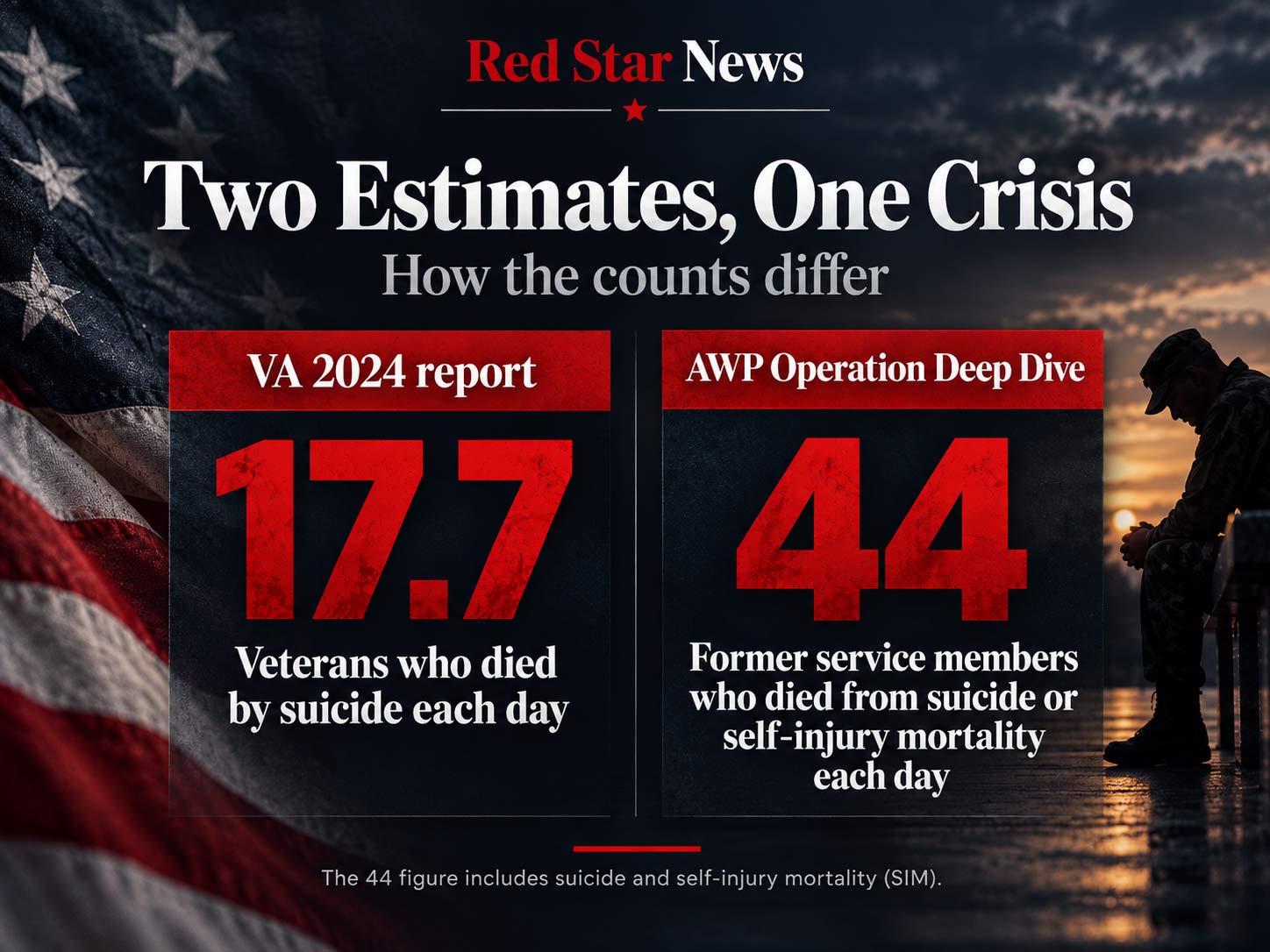
Research from America's Warrior Partnership's Operation Deep Dive found an estimated 44 former service members per day dying from suicide and self-injury mortality combined.
That would represent more than 16,000 deaths annually.
So which number is right?
The answer is more complicated than simply choosing between 17.7 and 44.
The VA and America's Warrior Partnership are measuring the Veteran suicide crisis differently. Their methodologies, populations and definitions are not identical.
But the enormous difference between the two estimates raises an uncomfortable question that deserves far greater national attention:
Are thousands of deaths among former service members being left out of America's official Veteran suicide count?
Veteran Suicide Remains at Crisis Levels
The newest VA numbers are difficult to reconcile with any suggestion that the Veteran suicide crisis has been solved.
According to the VA, 6,488 Veterans died by suicide in 2024, averaging 17.7 deaths every day.
Perhaps even more concerning is who the VA is not reaching.
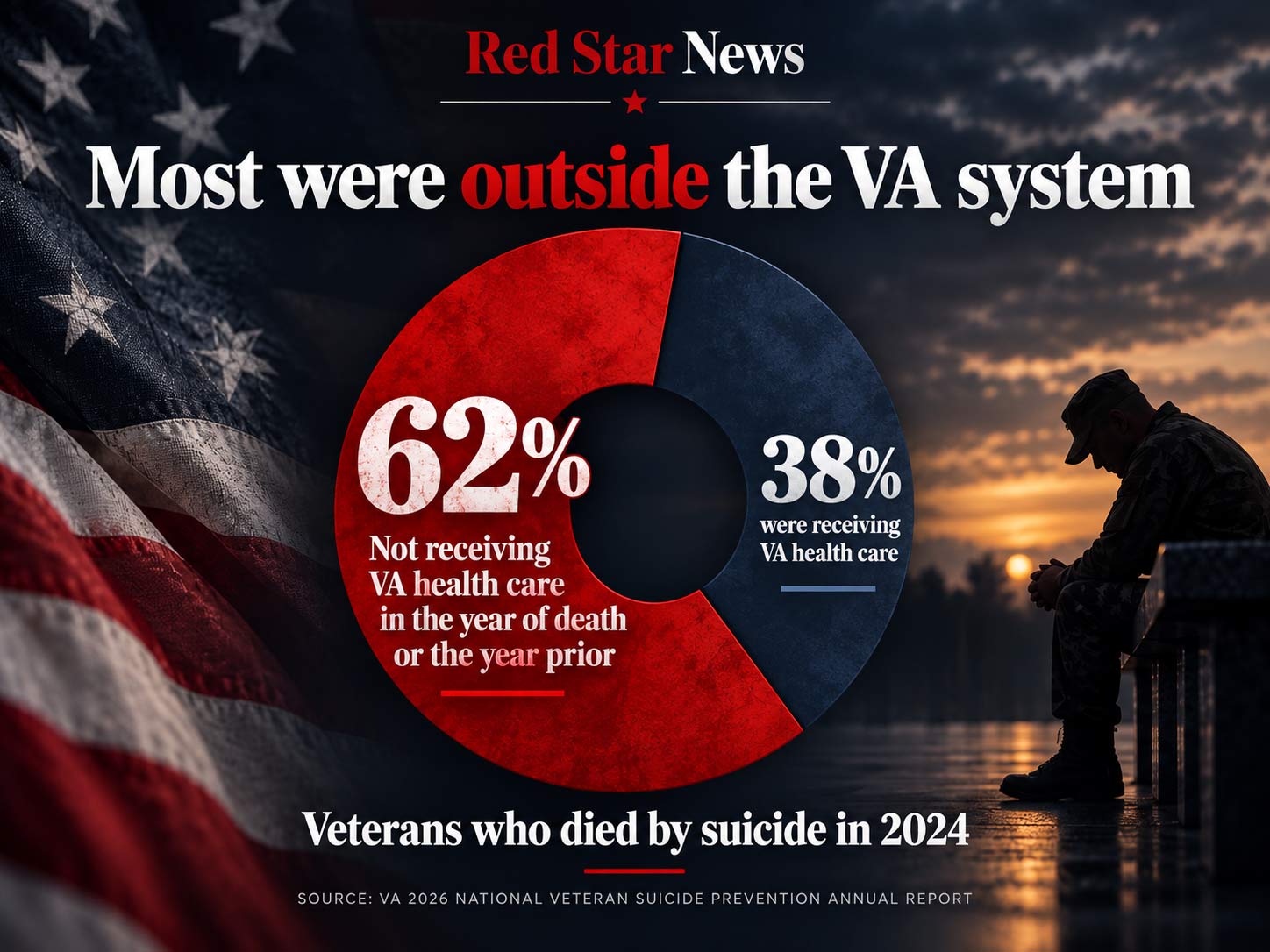
The report found that 62% of Veterans who died by suicide in 2024 had not received VA health care during the year they died or the previous year.
That means nearly two out of every three Veterans lost to suicide were outside the VA health care system during the period immediately preceding their deaths.
There was progress among Veterans receiving VA health care.
From 2023 to 2024, the suicide rate among Veterans enrolled in Veterans Health Administration care fell 4.8%.
But among Veterans who were not enrolled, the suicide rate increased 3.7%.
The long-term comparison is even more significant.
Between 2001 and 2024, according to the VA, suicide rates among Veterans enrolled in VHA care declined 2.2%.
Among Veterans who were not enrolled, suicide rates increased an astonishing 70.8%.
That should force a fundamental question about America's Veteran suicide prevention strategy.
How do we prevent Veteran suicide among the Veterans who never walk through the doors of the VA?
The Veteran Suicide Number America Usually Hears
For years, the national conversation surrounding Veteran suicide has largely been built around VA statistics.
Those statistics matter.
The VA conducts what it describes as the nation's largest annual analysis of Veteran suicide mortality, using national death certificate information and federal records to identify Veterans.
The newest data places the toll at 6,488 Veteran suicide deaths in 2024.
That is approximately:
540 Veteran suicide deaths per month.
125 per week.
17.7 per day.
Approximately one Veteran lost to suicide every 81 minutes.
Those numbers alone represent a national crisis.
But America's Warrior Partnership has raised serious questions about whether official suicide statistics capture the entire scope of the problem.
The 44 Per Day Finding
America's Warrior Partnership launched Operation Deep Dive to examine premature deaths among former service members.
The research went deeper into state death records and military service information, initially examining data from eight states:
Alabama, Florida, Maine, Massachusetts, Michigan, Minnesota, Montana and Oregon.
The findings were striking.
Operation Deep Dive reported a rate of approximately 24 former service members per day whose deaths were classified as suicide.
That figure alone exceeded the VA's national daily Veteran suicide estimate being reported during the study period.
But researchers identified another category that dramatically increased the estimated death toll.
Approximately 20 additional former service members per day were estimated to be dying from what researchers categorized as self-injury mortality, or SIM.
Combined:
24 suicide deaths per day
plus
20 self-injury mortality deaths per day
equals
at least 44 former service member deaths every day.
That translates to approximately 16,060 deaths annually.
Or about one death every 33 minutes.
America's Warrior Partnership currently describes the finding as an "at least 44 former service member daily suicide/SIM rate."
That distinction matters.
It would not be accurate to say that Operation Deep Dive proved 44 Veterans die by suicide every day.
What the research suggests is arguably more complicated and potentially more concerning.
Some deaths that may involve self-harm might never be officially recorded as suicide.
Are Some Veteran Suicide Deaths Being Classified as Something Else?
This is one of the most important questions raised by Operation Deep Dive.
Determining whether someone intentionally took their life is not always straightforward.
Consider an overdose.
If investigators can establish intent, the death may be classified as suicide.
But if there is not enough evidence to determine intent, that same death could potentially be classified as accidental or undetermined.
The person is still dead.
The family has still lost someone.
But that death may never appear in the official suicide statistics.
Operation Deep Dive attempted to examine this gap by including self-injury mortality, a broader category that can include certain overdose and undetermined deaths associated with self-harm.
This methodology produced a much larger estimate of the number of former service members dying prematurely from suicide and self-injury.
That raises a critical issue for policymakers and Veteran suicide prevention organizations.
If suicide prevention policies are built almost exclusively around deaths officially coded as suicide, what happens to the deaths that fall outside that classification?
Another Problem: Are We Correctly Identifying Everyone Who Served?
Operation Deep Dive uncovered another concerning issue.
According to America's Warrior Partnership, the eight states examined in its research undercounted former service member deaths at an error rate of approximately 25%.
That finding goes beyond the question of whether a death was classified as suicide.
It raises another question:
Was the person who died even correctly identified as someone who previously served in the military?
America's Warrior Partnership uses the broader term former service member rather than relying exclusively on traditional Veteran classifications.
That can include people who served in the active military, National Guard or Reserve components.
Different government databases do not always contain identical information.
A death certificate may not perfectly reflect someone's military history. State and federal data systems may identify individuals differently. Some people who served may not meet particular VA eligibility definitions.
Each of those issues creates another potential opportunity for a death to disappear from the Veteran suicide statistics Americans ultimately see.
Why 17.7 and 44 Should Not Be Directly Compared
The two numbers are frequently placed side by side, but they are not measuring exactly the same thing.
The VA's 17.7-per-day figure represents Veterans whose deaths were officially classified as suicide using national mortality data and VA's Veteran identification methodology.
The America's Warrior Partnership 44-per-day figure combines estimated suicide deaths among former service members with additional self-injury mortality deaths.
There are other differences as well.
Operation Deep Dive's original findings were based on eight states rather than a nationwide census.
The studied population and age parameters were also different from the VA's national Veteran population.
For these reasons, it would be incorrect to say:
"The VA says 17.7 Veterans die by suicide every day, but the real number is definitely 44."
The available research does not establish that conclusion.
What it does establish is reason to investigate further.
A more accurate question is:
Does the VA's official Veteran suicide count capture the full scope of preventable deaths among people who served?
Operation Deep Dive suggests the answer may be no.
More Than 16,000 Deaths a Year?
If America's Warrior Partnership's broader estimate reflects the national scope of suicide and self-injury mortality among former service members, the consequences are staggering.
44 deaths per day.
Approximately 308 every week.
More than 1,300 every month.
More than 16,000 every year.
That would mean the Veteran and former service member suicide crisis is potentially far larger than the number most Americans hear.
But even if the broader estimate ultimately changes as more states and additional data are studied, the research exposes weaknesses that cannot be ignored.
The country needs to know how many people who served are dying.
It needs to know how they are dying.
And it needs to know whether preventable deaths are disappearing into categories such as accidental overdose, undetermined death or other non-natural causes.
Without accurate data, America cannot accurately measure whether its Veteran suicide prevention strategy is working.
The VA's Own Numbers Reveal a Major Weakness
There is another finding in the VA report that may be even more important than the debate over 17.7 versus 44.
Sixty-two percent of Veterans who died by suicide were not receiving VA health care during the year of their death or the previous year.
That is not a minor statistic.
It points directly toward one of the greatest weaknesses in America's current Veteran suicide prevention system.
The VA can develop world-class suicide prevention programs.
It can expand mental health services.
It can conduct millions of suicide risk screenings.
It can operate the Veterans Crisis Line.
All of those efforts matter.
But they cannot fully protect a Veteran who never enters the system.
America cannot build its entire Veteran suicide prevention strategy around waiting for someone in crisis to seek help.
Veteran Suicide Prevention Must Begin Before Crisis
The national discussion about Veteran suicide has traditionally focused heavily on mental health treatment and crisis intervention.
Those services are critical.
But suicide prevention cannot begin when someone is already standing at the edge of a crisis.
Prevention must start earlier.
It must happen in communities.
It must happen among friends.
It must happen inside families.
It must happen among other Veterans.
It must happen when someone begins withdrawing, isolating themselves or losing their sense of purpose and belonging.
That is why community-based Veteran suicide prevention and peer-to-peer connection are so important.
For the Veterans outside the VA system, another Veteran, family member, friend, coworker or community organization may be the only person positioned to recognize that something is wrong.
The newest VA report provides powerful evidence of why America needs both clinical care and community-based prevention.
We Cannot Become Comfortable With 17.7 Veteran Suicides Per Day
A decline in one group or during one year should be recognized.
But perspective matters.
6,488 Veterans still died by suicide in 2024.
Imagine 6,488 empty chairs.
Imagine 6,488 families receiving a phone call or knock on the door.
Imagine losing more than 17 Veterans today.
Then doing it again tomorrow.
And the next day.
And the next.
That is not a problem America should normalize simply because one year's rate moved slightly in the right direction.
At the Red Star Foundation, we believe America must move farther upstream in Veteran suicide prevention.
We have to reach Veterans before they become suicidal.
We have to fight isolation and loneliness.
We have to rebuild connection, purpose and belonging.
We have to create trusted peer networks that reach Veterans where they live.
And when a Veteran dies by suicide, we cannot ignore the family left behind. Suicide does not end with one death. Its impact moves through families, friends, fellow Veterans and entire communities.
The Question America Must Answer
The VA's newest Veteran suicide report and America's Warrior Partnership's Operation Deep Dive should not be viewed as competing studies where one must be right and the other wrong.
They should be viewed together.
The VA tells us that 6,488 Veterans died by suicide in 2024.
America's Warrior Partnership warns that the broader universe of suicide and self-injury mortality among former service members could be significantly larger.
The difference between those findings should trigger more research, better data sharing and deeper examination of overdose deaths, undetermined deaths and how former military members are identified in state mortality records.
Because behind this debate is a question far more important than which organization has the correct statistic:
How many men and women who once wore the uniform are we actually losing?
Until America can confidently answer that question, we cannot confidently say we understand the Veteran suicide crisis.
And regardless of whether the number is 17.7, 24 or 44 per day, one conclusion is indisputable:
The Veteran suicide rate remains far too high.
Thousands of Veterans and former service members continue to die.
Thousands of families continue to be changed forever.
America should not be satisfied with managing those numbers.
The mission must be to drive them down.
If You or a Veteran You Know Needs Help
Veterans do not have to be enrolled in VA benefits or VA health care to contact the Veterans Crisis Line.
Call 988 and press 1
Text 838255
Visit VeteransCrisisLine.net
Support is available 24 hours a day, seven days a week.
Filed under: Veteran Suicide · Veteran Suicide Statistics · VA Veteran Suicide Report · America’s Warrior Partnership · Operation Deep Dive · Veteran Suicide Prevention · Self-Injury Mortality
All news