

New research from Duke University and America’s Warrior Partnership reveals a troubling reality about veteran suicide: The need for support can extend decades beyond military service.
The findings, announced Nov. 18 through America’s Warrior Partnership’s Operation Deep Dive research initiative, challenge the idea that suicide prevention efforts should focus primarily on the first few years following military separation.
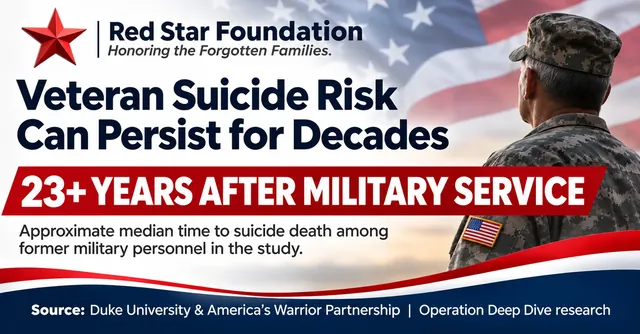
In Massachusetts and Minnesota, researchers found that the median time between military separation and suicide death exceeded 23 years among former military personnel included in the study.
The research underscores the importance of a long-term approach to veteran suicide prevention, including sustained community engagement, meaningful relationships, proactive outreach and access to support throughout a veteran’s lifetime.
Suicide Deaths Occur More Than Two Decades After Service
The study, published Sept. 21, 2026, in the American Journal of Epidemiology, examined 176,719 death records involving adults ages 18 to 64 in Massachusetts and Minnesota.
Researchers linked death certificates with military personnel records to better understand mortality patterns among former military personnel, including National Guard and Reserve members.
Of the individuals studied, 16,818 had previously served in the military.
Among former military personnel who died by suicide, researchers found:
- Massachusetts: The median time between military separation and suicide death was 23.1 years.
- Minnesota: The median time between military separation and suicide death was 23.9 years.
- Elevated suicide mortality: Former military personnel experienced higher suicide mortality than people without prior military service in both states.
- Additional concerns: Researchers examined alcohol-related and drug-related deaths alongside suicide, collectively categorized as “deaths of despair.”
Researchers also identified differences associated with military service history, including higher proportions of deaths of despair among former Coast Guard, Marine Corps and Army personnel and individuals with certain less favorable discharge characterizations.
These findings identify important patterns for further investigation but do not establish that military service, branch affiliation or discharge status directly caused the deaths.
Military Transition Is Important, but Prevention Cannot End There
Military transition remains an important period for suicide prevention. Veterans leaving service may experience changes involving employment, financial stability, family relationships, personal identity and the loss of familiar military communities.
However, the new research demonstrates why focusing primarily on that transition period is insufficient.
A veteran who separated from military service 20 or 30 years ago may still encounter challenges involving physical health, chronic pain, financial difficulties, substance use, isolation, grief or changes in personal relationships.
The study did not determine what caused individual suicide deaths or establish that an individual veteran’s suicide risk increases with time since separation. Rather, it documented that many suicide deaths occurred long after military service ended.
Suicide prevention must address both periods of heightened risk and the ongoing needs of veterans throughout their lives.
The Importance of Connection and Community
For Red Star Foundation, the research reinforces the importance of building lasting relationships and creating opportunities for veterans to remain connected with others.
The foundation’s approach to suicide prevention emphasizes three core principles: Hope, Recognition and Connection.
Through its Peer-to-Peer Network, Red Star Foundation is working to establish community-based relationships through regular gatherings, shared experiences, recreational activities and ongoing engagement.
The objective is to create opportunities for meaningful connection before someone experiences a crisis rather than relying exclusively on intervention after warning signs emerge.
The findings also reinforce the value of reaching veterans who may not be actively seeking mental health treatment, participating in traditional veteran organizations or receiving services through the Department of Veterans Affairs.
Community organizations, families, friends, employers and fellow veterans can all play important roles in maintaining contact and helping individuals find appropriate support when challenges arise.
Although this study did not evaluate Red Star Foundation’s programs or establish the effectiveness of particular interventions, its findings strengthen the rationale for investigating and expanding sustainable, community-based approaches to prevention.
Connecting Veterans With Resources at Every Stage of Life
The research also highlights the importance of making support accessible regardless of how long someone has been separated from military service.
Red Star Foundation recently launched its National Suicide Prevention & Postvention Resource Directory, initially featuring 492 organizations providing assistance to veterans, current military, first responders and surviving families.
The free directory helps individuals locate organizations offering mental health services, peer support, crisis assistance, substance use recovery, financial assistance, family support and other resources.
By bringing these organizations together in a searchable national directory, Red Star Foundation aims to make assistance easier to discover and help community organizations connect individuals with appropriate services.
The directory also addresses postvention, recognizing that families who lose someone to suicide may need support long after their loved one’s death.
A Lifelong Commitment to Those Who Served
America’s Warrior Partnership and Duke University deserve recognition for research that continues to deepen our understanding of veteran suicide and the factors associated with premature mortality.
Their findings raise an essential question for policymakers, veteran organizations and communities nationwide:
If veterans continue dying by suicide decades after leaving military service, shouldn’t our commitment to suicide prevention continue throughout their lives?
Effective prevention requires more than identifying a veteran during a moment of crisis. It requires ensuring that opportunities for connection, recognition and support remain available through every stage of life.
For Red Star Foundation, that commitment extends beyond preventing suicide. It includes recognizing and supporting the spouses, children, parents and loved ones left behind when prevention fails.
A veteran’s service may end, but our responsibility to those who served — and the families who love them — should not.
Hope. Recognition. Connection.
Honoring the Forgotten Families.
Research Sources
The study was conducted by Duke University researchers Katelyn M. Holliday, Elliot D. Hill, Heather R. Batchelder, Ashley E. Price, Candice Y. Johnson, Anthony J. Viera and Truls Østbye through Operation Deep Dive, a research initiative of America’s Warrior Partnership in collaboration with Duke University. Red Star News, published by Red Star Foundation, reported on the findings. Red Star Foundation did not conduct this research.
- Primary research: Deaths of Despair among Former Military Service Members, Massachusetts (2014-2021) and Minnesota (2014-2022), American Journal of Epidemiology, published Sept. 21, 2026. DOI: 10.1093/aje/kwag233
- Research announcement: New Operation Deep Dive Research Reveals Veteran Suicide Risk Can Persist Decades After Military Service, America’s Warrior Partnership, Nov. 18, 2026.
Red Star News is published by Red Star Foundation. About Red Star Foundation · Contact Red Star News
Filed under: Veteran Suicide · Veteran Suicide Research · Operation Deep Dive · America's Warrior Partnership · Duke University · Veteran Suicide Prevention · National Resource Directory
All news